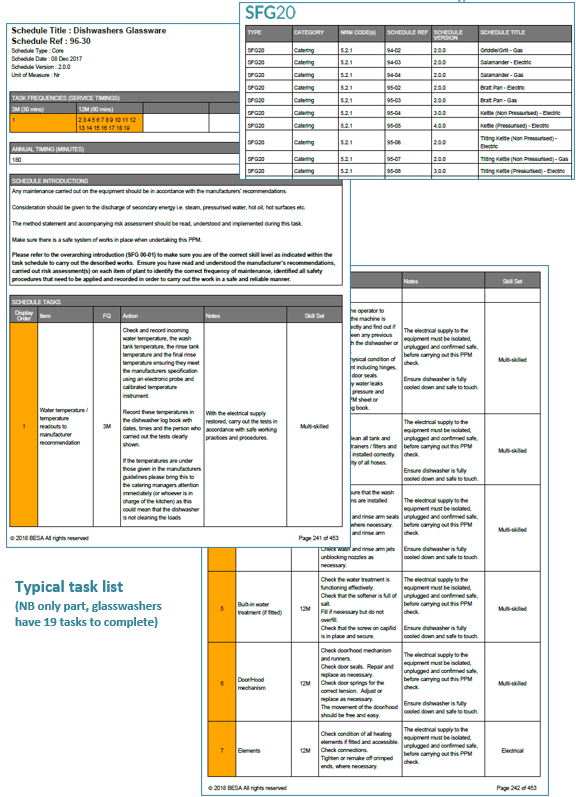
What is SFG20?
In 1990, in answer to customer and contractor demand, the Building Engineering Services Association, launched the industry standard for building maintenance specification. There are now hundreds of schedules from Automated Doors & Gates to Workplace Safety Equipment. Access to these schedules is by subscription.
In 2014, a customer approached SFG20 to request schedules for commercial kitchen equipment. SFG20 in turn approached the Catering Equipment Suppliers Association (representing 190 manufacturers and agents for manufacturers in the UK) who produced and delivered the first catering schedules in January 2016. The standard is normally reviewed and updated annually.
For the first time, there exist schedules for maintenance tasks which demonstrate
- Compliance
- Best practice
- The impartial, industry recommendation on which specific tasks needs to be done and when
Manufacturers’ recommendation ?
SFG20 is not the same as Manufacturers’ recommendation and the reality is that this much-used phrase is a delusion: no-one, past the initial installation, either uses or has access to the manufacturers’ instructions.
Apples with Apples
What this does address is that, however impressive the scope of work presented (or not), there has not been a universal standard for catering maintenance – and “service visits” will vary from cursory visual inspection to panels-off comprehensive preventative maintenance. Customers have, naively, assumed there was a standard which all applied – now, for the first time, there is, including timing.
But
Requiring service to be carried out to SFG20 standards on a tender document is a continuation of the naivety: how is this, complex (a different task list for each appliance), going to be implemented in the field? How will the customer have sight of the granular details of these tasks? These should be parallel questions any time SFG20 is specified. This simply cannot be done on paper job sheets…
Frequency
By the nature of the standard, service intervals are not driven by useage but rather by calendar. This is sub-optimal – there is clearly a difference in likely requirement between a school operating less than 1000 hrs a year and a hospital operating 6000 hours. This should be addressed on a case-by-case basis.