



Introduction
Climate Change: THE global challenge for the next 100 years.
And the way in which refrigeration is delivered will be a multiplier of any adverse impact, either in the refrigerants which are used or in the increasing burden of coping with higher ambient temperatures.
Tragically, on the one hand, there are climate-change deniers, carrying on with unsustainable practices and on the other, there are no enforcement measures for the good practice which has been legislated. We know from regular experience – and in surprisingly high-profile places – that “topping up” is widespread – and how could it be otherwise if there is no risk of being found out and fined?
MCFT will, withing the constraints of local practice in the countries in which it operates, not only uphold best practice but make sustained efforts to inform our customers on sustainable practice and equipment choices. MCFT will join with partners to:
- Ensure that we do follow the best attainable practices in each territory in which we operate
- Ensure that our technicians are trained and continually assessed for compliance with procedures
- Promote the use of low Global Warming Potential (GWP) refrigerants wherever possible
- Actively support the introduction of energy-efficient equipment and procedures
- Encourage the use of digital temperature monitoring to ensure food safety
Specifically, nowhere in our operations, in any territory, will our technicians “top up” refrigeration systems without first having identified and cured the cause of the short-fall in refrigerant.
Wherever possible – recycling facilities do not exist in every territory and some markets have yet to adopt recovery practices – we will document and account for refrigerant dispensed and recovered and keep records of compliant disposal.
Food Safety
The other facet of MCFT’s responsibility for maintenance of refrigeration systems is around Food Safety and, in particular, ensuring that appliances operate within the appropriate parameters and, if not, to report same along with recommendations.
This may include observations on use of equipment, suggested repairs or replacement. Although not Environmental Health Officers or offering that service, where observed, MCFT will also comment on food storage, hygiene and handling practices.
Legal, regulatory and compliance
Climate change and F-Gas
Recognised for some time and the first international effort to agree common actions was the Kyoto Protocol in 1997 which created the
UN FrameworkConvention on Climate Change. This was supplemented by the
Paris Agreement in 2015 addressing sustainable development, although not having the force of law.
Refrigerant gases started to be addressed by the Montreal Protocol in 1987, supplemented by the Kigali Amendment 2019. The European Union Regulation 517 of April 2014 controls the use and future plans for fluorinated gases.
The British government has sort-of loose plans for following these grand ideas but not so long as they end up costing money or require some form of monitoring arrangement. And following Brexit, will care even less. Less facetiously, globally recognised food operators flout the rules with impunity because there is no monitoring and, without monitoring there can be no sanction.
There are four basic precepts to good maintenance practice (as not actually controlled):
- Leak prevention – ban on “topping up”
- Phasing out of higher GWP refrigerants
- Trained technicians
- Record keeping
Leak prevention
If many refrigerants are harmful, it follows they must not be allowed to escape to atmosphere. If, on examination, a refrigeration system is found to be short of refrigerant, there must have been a leak. The approach is therefore that the leak must be found and addressed before any refrigerant can be added – which would otherwise simply leak again.
This leads to three cost and time consequences – during which the equipment may not be useable:
- finding the leak can take time – the smaller the leak, the more difficult to find and it may require several hours of pressure test.
- solving the problem – which may include replacement of key components, some of which may require special fabrication.
- operational disruption – it may be that there is sufficient spare storage that this is not an issue – or it may be, for example in 7-day, all day retail operations, that this is profoundly disruptive and has additional financial impact in lost potential sales.
In the “old days” – and, sadly, in the absence of meaningful surveillance and sanction, a practice we see returning – refrigeration engineers would simply “top-up” and this might keep the equipment performing for another month or more.
The rules are now very clear – even if not enforced : you may not “top-up” a system until the leak has been identified and repaired.
Furthermore, depending on weight and type of refrigerant charge, you may need to carry out (and be able to demonstrate compliance – this is a question which the Environment Agency may ask) leak checks on coldrooms – and, for very large systems , a leak detection system may be a mandatory requirement.
Phasing out of higher Global Warming Potential Refrigerants
The Montreal Protocol sets out targets for the removal of the most damaging refrigerant gases. Whilst manufactures will no longer produce equipment using these, there remains a vast legacy inventory of systems using these refrigerants.
Certain gases are simply no longer available in developed countries (they are readily available in the Middle East); certain gases have restricted supplies and therefore become more expensive as stocks diminish.
The preferred and simplest alternative has been to move to hydrocarbon refrigerants – tempered by concerns about the flammability and risks associated, especially in commercial kitchens with sources of ignition in proximity. Over the last years of increased distribution and prevalence, initial restrictions (150gm) which limited capacity of equipment (insufficient for coldrooms, display counters or blast-chillers) are in the process of revision.
Further options include Carbon Dioxide refrigeration systems but these have typically been expensive and have achieved limited diffusion in the hospitality sector.
Hydrocarbon Refrigerant Gases:
| R290 | Propane |
|---|---|
| R600 | Isobutane |
| R170 | Ethane |
| CARE30 | Blend 600/290 |
| CARE50 | Blend 290/170 |
Trained and competent technicians
In the EU and UK, no-one may break in to a refrigeration system without the appropriate F-Gas qualification and no businesses may operate in the field without being able to demonstrate that all technicians are qualified.
It’s important to note that this indicates nothing at all with regards to the competence of the technician to fault-find or to effect repairs to the requisite level, this is simply about the safe and compliant handling of fluorinated gases.
Some qualifications require 5-yearly re-accreditation, some do not.
City & Guilds 2019 – Handling Fluorinated Gases (NB different levels – Level 1 – all activities, Level 4 – not breaking into system)
In the UK, Businesses must be registered either with Refcom or F-Gas register and must be renewed every three years.
Law
REGULATION (EU) No 517/2014 OF THE EUROPEAN PARLIAMENT AND OF THE COUNCIL - F-GAS
Prevention of emissions of fluorinated greenhouse gases
- The intentional release of fluorinated greenhouse gases into the atmosphere shall be prohibited where the release is not technically necessary for the intended use.
- Operators of equipment that contains fluorinated greenhouse gases shall take precautions to prevent the unintentional release (‘leakage’) of those gases. They shall take all measures which are technically and economically feasible to minimise leakage of fluorinated greenhouse gases. Where a leakage of fluorinated greenhouse gases is detected, the operators shall ensure that the equipment is repaired without undue delay.Where the equipment is subject to leak checks under Article 4(1), and a leak in the equipment has been repaired, the operators shall ensure that the equipment is checked by a certified natural person within one month after the repair to verify that the repair has been effective.
- Natural persons carrying out the tasks referred to in points (a) to (c) of Article 10(1) shall be certified in accordance with Article 10(4) and (7) and shall take precautionary measures to prevent leakage of fluorinated greenhouse gases. Undertakings carrying out the installation, servicing, maintenance, repair or decommissioning of the equipment listed in points (a) to (d) of the Article 4(2) shall be certified in accordance with Article 10(6) and (7) and shall take precautionary measures to prevent leakage of fluorinated greenhouse gases.
Record Keeping
There has been confusion about responsibilities, in particular, from owners and operators of refrigeration. The following is UK Government guidance to owners:
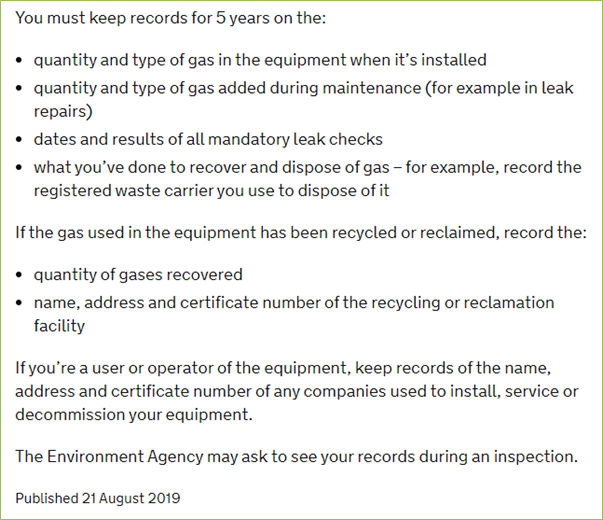
MCFT will document and retain records of refrigerant charged and reclaimed, along with delivery and disposal of equipment but cannot take legal responsibility for inventory, especially when initial, ongoing or subsequent supply and maintenance may have been by others.
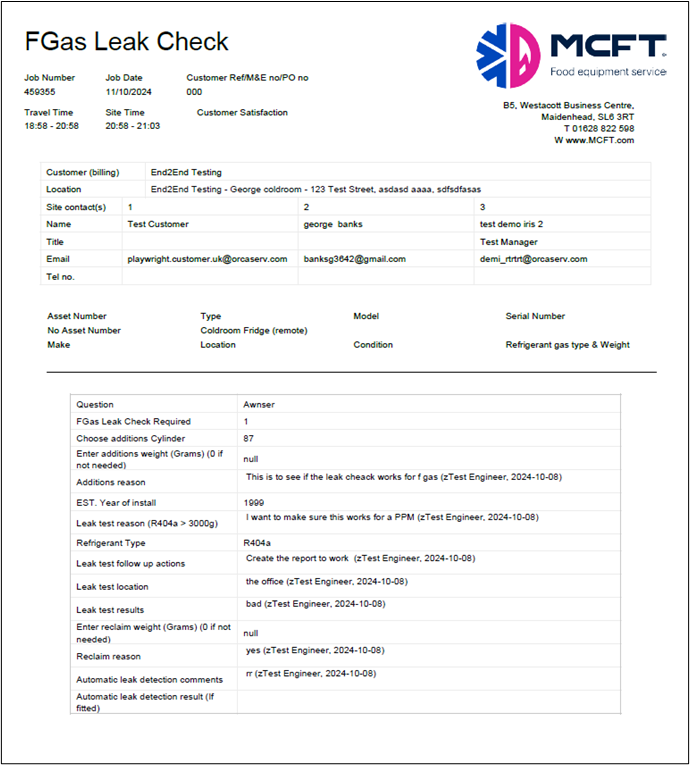
Example of F-Gas record keeping or report
Filling in Waste Consignment Notes
A Waste Consignment note must be completed when the service engineer transports hazardous waste recovered during servicing and maintenance of refrigeration or air conditioning equipment, from the site directly back to the wholesaler. Under the Hazardous Waste Regulations of 2005 a consignment note needs to be completed when removing and transporting any hazardous waste from refrigeration and air conditioning systems.
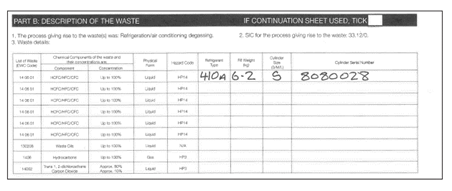
The example uses a typical consignment note from a wholesaler. The majority of wholesalers have their own version of a consignment note, specific to the refrigeration industry, which is based on the Environment Agency Template. Below is an example of how you might fill in such a consignment note, with fictional details included.
Note: In other situations, such as the wholesaler collecting recovered refrigerant from the site or when plant is being decommissioned, the consignment note will need to be completed differently. If you have any questions, you should contact your refrigerant supplier or the Environment Agency for more specific guidance.
Part A – Notification details, as a technician removing refrigerant from the equipment on site into a cylinder you must complete part A and B of the consignment note.
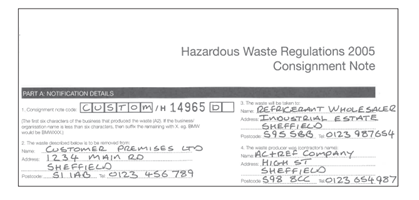
Section 1: Put in the first six letters of the name of the site you are removing the refrigerant from, if the site name doesn’t have six letters put an X in all the blanks. In the second section put the letter D unless your removing the refrigerant from a ship, in that case put the letter V
Section 2: The name and site address you are removing the refrigerant from needs to go this section.
Section 3: The name and address for wholesaler the cylinder is to be returned to goes in this section (example: HRP).
Section 4: The name and address of the company you work for needs to be in this section.
Part B – Description of the waste
Food Safety
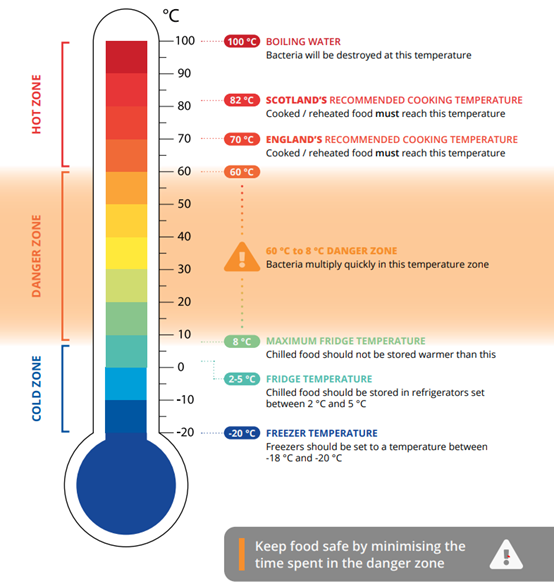
The primary purpose of refrigerated storage is to extend the life of perishable and temperature sensitive foodstuffs. The consequences of failure include:
- Stock loss: failed plant, when identified in time, can lead to significant financial loss and operational impact from necessarily discarded foodstuffs. The impact may extend to lost business and reputational damage.
- Food Poisoning: if not identified, uncontrolled storage can lead, more seriously, to food poisoning – possibly fatal.
The food safety aspects of refrigeration would include :
- Controlled supply chain – with rapid movement through ambient areas – for example deliveries of product onto a loading dock – with timed transition from chilled transport to chilled storage
- emperature monitoring during storage: can be manual with periodic verification and record-keeping; prone to abuse.
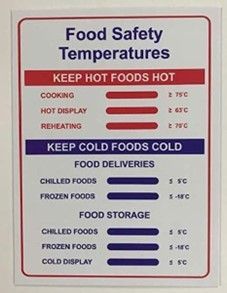
- Fast chilling: if food is cooked in advance of requirement, it must be brought down to storage temperature within 90 minutes.
- Appropriate and adequate storage.
- Good practice in storage: separation to avoid cross-contamination along with stock rotation (internally prepared food date labelled).
- Chilled at point of use – whether mise-en-place in the kitchen or on display in a servery area.
- Fast re-generation (re-heating).
Cross-contamination
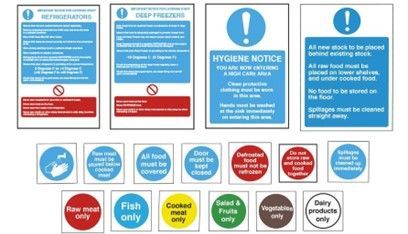
Good practice will involve separate preparation and use of different boards and containers and when it comes to storage:
- cover raw food, including meat, and keeping it separate from ready-to-eat food
- use any dish that has a lip to prevent spillages
- store covered raw meat, poultry, fish and shellfish on the bottom shelf of your fridge – never store raw food over cooked food
- use different utensils, containers and prep equipment for raw and cooked food
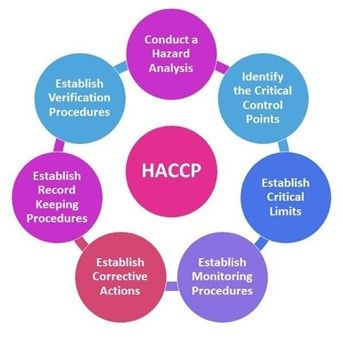
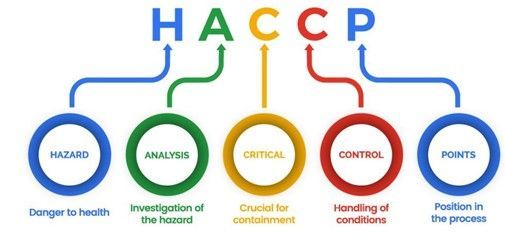
A full HACCP assessment would mandate for a structured flow of foodstuffs through from delivery, un-crating into storage, onward handling through preparation, pre-cooking, chilling, chilled covered storage before despatch – whether chilled service or for re-heating, temporary holding and hot service. This would include the temperature and rotation monitoring regime as well as the minimised, safe and compliant disposal of waste foodstuffs.
Alongside, controls would include vetting of food suppliers and their activities, including transport; training of staff – in hygiene, storage and food handling. And evaluation of technology which might, for example, provide cheaper, more continuous and more accurate storage temperature readings than a manual process. (see note below about temperature readings)
Storage temperatures
Whilst most catering operations would be aware of the need for controlled storage, they may not be aware of the pitfalls:
- Heat gain during loading or unloading (especially if doors are left open)
- Impact of heat gain on entire contents of cold storage not just the consignment
- Defrost cycles and on/off parameters
- Position at which temperatures are monitored
- Core temperatures
- Position of probes: in order to “achieve” temperature, it has been known for technicians to fit probes in the off-air stream from the coil – i.e. at the coolest point. The mean temperature in the cabinet can be as much as 8 degrees warmer – putting food storage at risk.
In order to perform as required, equipment needs to be:
- Appropriately specified: purpose, nature of foodstuffs, volumes and timing of traffic will determine the requirement.
- Provided in accordance with the spec – not allowing down-grading of plant in order to trim costs
- Installed in line with guidelines: all refrigeration requires ventilation – we are constantly surprised at installations into inappropriate locations by people who should know better
- Used as intended – storage and usage (access) as proposed
- Cleaned and defrosted as required by the users and in accordance with instructions (do not use knives on door gaskets!)
- Monitored for temperature
- Periodically checked by the users for key signs: ill-fitting or damaged gaskets, noise from fans, build-up of ice, water leaks - which might prompt a service visit
- Maintained by technicians at appropriate intervals: ensuring coils are clear of build-up of dust, grease or ice
Risk
In providing maintenance services, MCFT incurs risks and will seek to mitigate those risks:
Compliance
- Food safety responsibility to ensure equipment is operating as intended and fit for purpose
- Adhering to F-Gas regulations as currently in force (continuously evolving)
- Documented, industry best-practice, detailed logging of all interventions
Commercial
- Equipment down-time may restrict customers’ revenue stream or incur costs: MCFT will react promptly to all operational impact incidents and will keep customers informed as to resolution options and all steps on the time line.
- Stock loss from equipment outage may be significant: MCFT will institute training and procedures to ensure risks are identified and communicated and processes followed to minimise the risk of stock loss.
- Fire: in carrying out repairs and component replacement, MCFT technicians may need to use hot works for example to braze fridge lines. There will always be clear communication with customers prior to carrying out any hot work, local procedures will be followed, including, where appropriate, attendance out-of-hours and strict procedures will be followed during the hot work activity including ensuring there is always a fire watcher.
- Reputational damage may result from, for example, a food poisoning incident. MCFT will ensure that service visits document all efforts being made to ensure any such risk is minimised, including the documented calibration of temperature gauges.
Opportunity
Sales people, during initial surveys, have an opportunity to:
- superficially assess condition (age, original spec, user and service provider upkeep regime)
- based on condition, location and usage, to recommend appropriate maintenance regimes
Technicians, during maintenance visits, have opportunities to comment and advise on:
- Safe working practice by users : storage
- Hygiene and pest control
- Possible equipment issues with impartial recommendations to limit same
The Contract with the Customer
MCFT will provide:
- Rapid, appropriate response, communication and resolution
- Allocated personnel – from service desk through field team along with clear paths for escalation
- Trained, qualified, continuously assessed technicians
- Fully compliant interventions at all times – food safe and F-Gas regulations
- Clear explanation of all activities and recommendations, with
- Industry-recognised and approved planned maintenance programs , based on SFG20
- Insight and impartial advice on equipment and best practice
In return, Customers will be expected to provide:
- Clear instructions on authority to act – in particular the use of Purchase Orders
- Afford the maximum flexibility in terms of access to site - it becomes very difficult to class a 72 hour notice period as “Urgent”
- Afford the maximum flexibility with regards to access to equipment – it’s equally difficult to work effectively without the catering team affording space and time in order to work
- Raise any concerns with work done or invoices submitted promptly
- Pay bills on time.
Training and Resource
MCFT is committed to ensuring that:
- Technicians are equipped with the skills they need to perform their roles
- Technicians are assessed, evaluated and developed
- New entrants are brought into the industry
| Number | First name | Last name | Email address |
|---|---|---|---|
| 1 | Anne | Evans | anne.evans@mail.com |
| 2 | Bill | Fernandez | bill.fernandez@mail.com |
| 3 | Candice | Gates | candice.gates@mail.com |
| 4 | Dave | Hill | dave.hill@mail.com |
Assessment and Audit
- All Technicians will have at least one documented, face-to-face field assessment every year.
- All technicians’ field work will be verified by subsequent audit at least once a year.
- Follow up actions in both cases will be recorded and closed out when complete under the oversight of the HR and Compliance teams.
The Refrigeration Technical Team will comprise of:
- The Field Service Manager
- The UK Refrigeration Training Manager
- Senior Team Leaders
- The GCC Technical Manager
Best practice
MCFT will always follow best practise, all technicians are equipped with the knowledge and tools to work in the best possible way to ensure your equipment is looked after properly, repaired to the best standard and done in the safest way.
Basic Principles
The image shows a basic refrigeration cycle, and while it may be basic, every refrigeration system requires the four basic components to function.
The purpose of refrigeration is to transfer heat energy from a “conditioned” space (inside your fridge) to another space (outside your fridge).
This means there are two sides to every refrigeration system:
- The Cold side – this side has low pressure low temperature refrigerant inside that is absorbing heat energy from the air inside the fridge.
- The Hot side – this side has high pressure high temperature refrigerant that is rejecting the heat into the space outside the fridge.
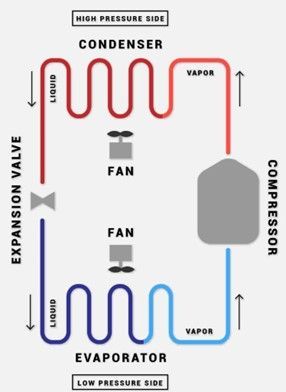
Separating the two sides you have the compressor and expansion device. The compressor is a pump and moves the refrigerant around the system. The expansion devise is a restrictor that lowers the pressure and temperature.
As in the picture there is a fan on each side, the fans are used to pass air over a heat exchanger (coil of copper) to increase the rate of heat transfer. Commercial system are designed with these fans and without the forced air flow provided by the fans the system will fail. This does not just mean fan failure but if the heat exchangers get blocked this will give the same result.
Most refrigeration systems are much
more complex and have many more components than this basic system, but this is the basic requirement for every refrigeration system.
F-Gas – Minimising environment impact
The F-Gas regulations are all based around minimising the environmental impact of any equipment that contains Fluorinated refrigerants. As such MCFT will always take every step to ensure your equipment has the least possible environmental impact. There are 2 ways in which we will ensure this.
Direct impact – this is direct effect of refrigerant has on the environment. We will maintain your equipment to best standard to help minimise leakage. Where leaks have occurred we will make safe and repair as soon as possible. We will work with you as an operator to advise, so you can fulfil your legal responsibilities set out in the F-Gas regulations. Which state that as an operator you shall take all measures which are technically and economically feasible to minimise leakages of all green house gases.
All the team are fully trained and F-Gas qualified, so the lowest possible amount of refrigerant is released when working on your equipment and will only break into a system (put gauges on) as a last resort, minimising the loss of refrigerant. They are also issued with equipment to keep refrigerant loss to a minimum like ball vales on gauges. Our team will always follow the F-Gas regulations meaning they will never “top up” a leaking system and will always recover refrigerant to be disposed of properly.
Indirect impact – this is the energy consumption of your equipment. Over the lifetime of your equipment indirect impact will account for 80% of the Carbon footprint of each unit. Our high standard of maintenance will reduce energy consumption and not only help the environment, but also help save on energy bills. Our team will always leave your equipment working in the most efficient way possible and will advise on any repairs that are reducing the efficiency and any solutions to improve further.
Since 2015 the regulations have required all systems to be labelled with their refrigerant information. It must state the refrigerant type, the mass of refrigerant, the GWP of the refrigerant and the CO2 Equivalent of the system.
PPM – Maintaining your equipment
We pride ourselves on offering the best maintenance of your equipment. This is so important to minimising environment impact your equipment has and keeping it safe for the direct users. Whether regular leak checks, to minimise leaking asap, keeping condensers, checking physical condition and making sure electrically sound. Everything we do on a PPM will enhance the safety, efficiency and length of life of your equipment.
Call outs – Reacting to breakdowns
The Refrigeration team understand the importance of prompt attendance to refrigeration equipment and we have members of the team located around the country to be able to attend breakdowns. The team all work to the highest safety understanding that break downs happen when things have gone wrong and safety awareness in paramount. The team are all equipped with a varied van stock and will always aim for a first fix solution. When this isn’t possible and further parts or equipment is required, Your equipment will always be left safe and you will be advised on best possible course of action.
Remedials – repairing your equipment
When return visits are required, whether as preventative repairs picked up on Maintenance or as essential repairs from breakdowns. All equipment will be securely isolated to ensure everyone’s safety. Refrigerant handling is always done inline with regulations to ensure safety and environment preservation. The team will always follow onsite procedures and acquire the relevant permits for any high-risk activities that can be required to repair the equipment.
Scope of works
Our team will always follow the scope of work set out for them; this is issued by us at the start of the contract. We work inline SFG20 standard[ which is the benchmark for optimum maintenance.
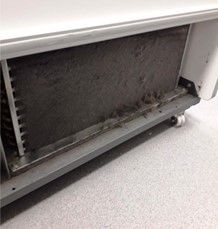
After MCFT – not just safe, more energy efficient and longer-lasting.
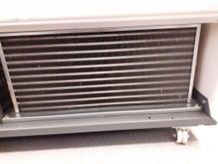
Wrong diagnosis:
An MCFT refrigeration Tech removed 600gms of refrigerant from a system to get it to work properly as it had been overcharged, the previous company tech had suspected undercharged & just topped up.
Incompetent technician – assumes its low, tops up and tops up again.
Refrigerant gases
Since the 1990’s, as a result of the Montreal and then Kyoto agreements, certain refrigerants have been identified as environmentally harmful and therefore phased out.
The outcome of these agreements has been a ban and phasing out of certain forms of refrigerant, harmful to the environment (either damage to the ozone layer or impact on global warming or both).
Chlorofluorocarbons (CFCs) such as R12 were banned in the early 1990’s, HCFC’s such as R22 have already been banned in Europe because of their very high global warming potential (GWP).
Under UK and EU legislation, a ban came into force on 1 January 2020 that will ban refrigerants with a global warming potential (GWP) greater than 2500 being used to service or refill your refrigeration or freezer system. This ban affects refrigeration systems containing hydrofluorocarbons (HFCs) equivalent to over 40 tonnes of carbon dioxide. This equates to around 10kg of R404A, a common refrigerant in medium sized systems. Smaller and hermetically sealed systems should be unaffected by this ban. Commonly used refrigerants that will be subject to this ban include but are not limited to R404A and R507A.
This means that a system containing less than 10kg of R404a can still be serviced and maintained until the full ban comes into effect in 2030. After 2030 any repairs that required the removal of the refrigerant or any leaks found on the system will require a new refrigerant suitable for the system or replacing the system for a newer low GWP option.
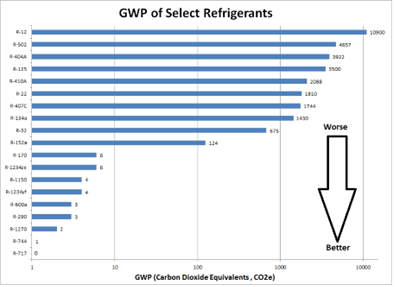
For a useful listing of refrigerant types and their impacts, visit the SWEP company website.
Note, although very damaging to the environment, R22 is still commonly available in the UAE.
Hydrocarbon Refrigerants (R290, Propane; R600, Butane ; R170. Ethane) (variants of Liquid Petroleum Gas). Used in the 1930s, Hydrocarbon refrigerants were relaunched in the 1990’s and their use has accelerated rapidly since the phased banning of HFC’s - such that all the major Western manufacturers standard product lines use R290 and other HC’s – for both domestic and small commercial applications.
F-Gas Register
The F-Gas regulations were brought in 2006 to reduce the amount of F-gas’s released into the atmosphere. In 2008 came a new qualification, the F-gas Qualification, which took over from the safe handling as the lowest minimum requirement to work with refrigerants. This new qualification gave much more emphasis on how refrigerants effect the environment and the importance of reducing the release to atmosphere while keeping all the safe handling. The F-gas register was created alongside the qualification to keep track of all the companies who work with refrigerants and to hold them accountable for following the regulations and ensuring proper training to all staff.
Why do companies need to be part of a F-Gas register?
Commission Regulation 2015/2067 of 2 April 2008 sets out the requirements for a company certification scheme for businesses working with stationary refrigeration air-conditioning and heat pump equipment containing or designed to contain fluorinated greenhouse gases (F-Gases) in accordance with Article 10.7 of EC Regulations 517/2014 on certain fluorinated greenhouse gases (the EC F-Gas Regulation).
What do the regulations seek to achieve
Fluorinated gases have a high global warming effect if released into the atmosphere.
The principal objective of the EC Regulation is to contain, prevent and thereby reduce emissions of F-gases covered by the Kyoto Protocol.
There are obligations in the F-gas Regulation (EC517/2014) and the Ozone Regulation (EC Regulation 1005/2009) that affect many industry sectors. In some cases, the obligations lie with the owner / operator of the equipment. In other situations, the obligations lie with third parties, such as equipment suppliers, maintenance contractors and waste handling companies.
The following is a summary of uses and sectors affected. More details of the various obligations and a full listing of affected sectors is available from the Environment Agency.
Stationary Refrigeration and Air-conditioning
Users of these systems have numerous obligations to prevent leakage of F-gas refrigerants. Refrigeration systems using hydrochlorofluorocarbons (HCFC) refrigerants such as R22 need to address a ban on the use of this refrigerant which came into force January 1st, 2015.
There are also many obligations that apply to Refrigeration system suppliers and maintenance contractors, especially related to the use of appropriately qualified personnel and certification of companies.
Who is responsible for compliance?
In the UK, the person having control of the equipment containing the F-gas refrigerant (the “operator”), typically a company, is likely to have responsibility. Also, any business employing personnel involved in refrigerant handling must ensure that they have the appropriate qualifications.
MCFT is registered with REFCOM which is the UK’s largest F-Gas Register. All of the Refrigeration team are qualified to F-GAS CAT1 which means they are able to carry out any task on any size system that contains fluorinated refrigerants.
Energy saving
Energy efficiency of refrigeration systems is governed by the laws of physics and bypracticality. Practicality embraces cost, cycle, safety, legislative requirements, refrigerant choice, and maintenance. Eficiency is not only dependent on choice of refrigerant but also on good design, selection of an appropriate system and good maintenance. Good efficiency is vital to minimize indirect emissions of carbon through energy use. To maximise efficiency attention needs to be paid to the following:
- Minimising the need for refrigeration and reducing the cooling load. This is the mostimportant first step – a system cannot be considered efficient if the cooling load is unnecessary
- Overall system design. For example, the most appropriate cycle, splitting loads at different temperatures onto different suction levels, etc
- Control philosophy. Including the “offdesign” operating conditions which are much morecommon than the peak “design point”, avoiding fixed head pressure control, avoiding partly loaded compressors, avoiding fixed speed auxiliaries like pumps and fans, etc.
- Optimise individual components for efficiency. For example, sizing of heat exchangers, selection of compressor for efficiency etc.
- Operate, monitor, and maintain the plant for best efficiency
Below are maintenance tasks that can improve efficiency and in turn help reduce the indirect environmental impact. The basic function of a refrigeration system is to absorb and reject heat. To get the best efficiency from a system is to ensure it can do this well.
Cleaning the condenser - he function of the condenser is to reject heat if it can’t it severely effects the efficiency of the system. When it can’t reject heat, it increases the temperature of the refrigerant in the condenser. For every 1o C the refrigerant increases above its design temperature, the system becomes 3% less efficient. So, if a blocked condenser causes the temperature in the condenser to raise 10o C above design the system will use 30% more energy to reach its temperature.
Cleaning the evaporator - the function of the evaporator is to absorb heat if it can’t it severely effects the efficiency of the system. When it can’t absorb heat from the space it decreases the temperature of the refrigerant in the evaporator and for every 1o C the refrigerant decreases in temperature below its design the system becomes 3% less efficient. So, if a blocked evaporator causes the temperature in the evaporator to fall 10o C below design the system will use 30% more energy to reach its temperature.
Cleaning fan blades – a dirty fan blade can reduce the amount of air it can move. As these are positioned to move air over the condenser and the evaporator it can have, he same effect as dirt as mentioned above.
Correct charge – The quantity of refrigerant in a system can affect the performance in much the same way as described above. If a system is under charged it will drop the temperature in the evaporator and so decrease efficiency. Likewise, if a system is over charged it will raise the temperature of the refrigerant and so reduce efficiency
Remote Systems
These are systems where the condensing unit is located away from the conditioned space and they are connected via a pipe run. These are used when environmental conditions near the conditioned space make it impractical or not possible to have an integrated system.
Such environmental conditions that may present the need for remote system:
- heat load – condensing units need a lot of cool air to reject enough heat to allow proper function. Placing outside can provide this naturally
- noise – condensing units contain motors that can be quite noisy so they can be placed remotely to reduce noise levels in serveries.
- space – some condensing unit simply take up to mush space that can be used more effectively by placing the condensing unit away from the space.
Care and thought must be given to the location of the condensing unit when placed remotely. The location needs to be able to provide suitable operating conditions year-round. So, placed in the shade so in summer so it doesn't suffer from excessive heat load. It is important to ensure they are positioned when their airflow will not be obstructed or effected by other sources. E.g., other condensing units blowing hot air onto your condenser or under a tree that loses its leaves in Autumn that could block the condenser coil.
Due to the additional pipe run, these systems can hold a lot more refrigerant than integral systems and very often fall into the requirement for regular leak checking. They can also make some repairs harder or more time consuming. For example, finding a leak on a system where pipes pass through multiple walls can be challenging. These jobs can also require multiple engineers to complete as the system can be hundreds of meters long.
From an energy saving point of view remote packaged systems can be great as you can run multiple chilled spaces with less compressors, sometimes as little as one. As the compressor is the major energy consumer of refrigeration systems it can reduce energy consumption considerably. However, having all your equipment on one system could mean serious issues if a complete failure occurred.
Other considerations with remote systems is the location of the outdoor unit in regards to safety or interrupting operations. An example being a condensing unit above a loading bay, where access is by positioning a tower in the loading bay. This may require a loading bay to be closed and unused for the duration of the task. If terms of safety, if a condensing unit is positioned on a roof top, this may require specialist training to complete a task. This could include harness training so engineers can work safely near the edge of a roof or have adequate barriers installed so work can be carried out safely.
Leak checking and detection
There is a requirement to ensure that all refrigeration systems are tight, meaning they are not leaking refrigerant. As part of this requirement there are regular leak check intervals set out in the F-Gas regulations, these are based on the mass of refrigerant in the system and the environmental impact of the refrigerant, detailed below. As the operator you have a legal requirement to have your systems leaked checked by a trained person at the correct intervals and to hold records of the leak checks for 5 years. MCFT will always provide the result of the leak check and this will be available should it become misplaced, as we also share the responsibility.
Each refrigerant is given a global warming potential, or GWP. This is a rating on how bad it is for the environment and uses CO2 as the base line of 1. So, if a refrigerant has a GWP of 2 it means it is twice as bad for the environment as CO2. Unfortunately, most refrigerants in use today are far, far worse for the environment and this is why regular leak checking is necessary.
Regular leak checking intervals are worked out using the CO2 equivalent of the refrigerant in the system.
- Less than 5 tonnes of CO2 equivalent – No regular leak check needs to be recorded.
- 5 – 50 tonnes of CO2 equivalent – 1 leak check per year.
- 50 – 500 tonnes CO2 equivalent 2 leak check per year.
- More than 500 tonnes CO2 equivalent – 2 checks per year and must have automatic leak detection.
Calculating CO2 equivalent of a system.
GWP x refrigerant charge (mass) in KG
e.g. R404a has a GWP of 3922 and a system has a charge of 1.5KG
so. 3922 x 1.5kg = 5883KG or 5.883 tonnes and so falls between 5 and 50 tonnes and needs leak checking once per year.
Types of leak detection used for regular checks
Visual – this means looking for visual signs of leakage; oil, fractures, or on the rare occasion you are there for its refrigerant vaporising as it leaves the pipes on a catastrophic leak.
Electronic leak detection – electronic leak detectors are very sensitive and can detect leaks as small as 3 grams per year. They can be used on all refrigerants that contain fluorine, so all CFCs, HCFCs and HFCs. Any refrigerants that do not contain fluorine will not be picked up by these. E.g. Hydrocarbons.
Leak spray or soapy water – when this is applied to the area of a leak it, even a tiny leak it will bubble up. Often used in conjunction with an electronic leak detector to help pin point a leak.
If a leak cannot be found using the above methods but the system is not performing as it should and showing signs of leakage in way of performance an invasive leak check may be required.
Pressure testing or tightness testing – this is used when all refrigerants has been lost or when a leak cannot be found using any of the other methods. For this oxygen free nitrogen (OFN) is put into the system up to a suitable pressure to enable the leak to be found. This is often used in conjunction with leak spray or soapy water to pinpoint a leak. When this is required it means all remaining refrigerant will need to be recovered, once the leak is repaired it will need to be double checked as tight, evacuated in line with regulations and recharged with fresh refrigerant as the old will have become contaminated.
CO2 systems
Currently MCFT do not work with CO2 Equipment.
If this is a service you require, we can arrange a company who specialise in this type of refrigeration to work on our behalf.
Flammable Refrigerants
Refrigerants are bad for the environment, some worse than others, and there is moved to reduce and eventually eliminate the worst of the refrigerants commonly used today.
The common element in the high GWP refrigerants that are being phased out is fluorine. Fluorine is the F in F-Gas and is what is controlled by the regulations. It is terrible for the environment and causes the high global warming potential in refrigerants. It was originally used in refrigerants because it reduces flammability to zero or near zero. Without fluorine refrigerants become hydrocarbons, which are the likes of Propane (R290) and isobutane (R600a). While these are great refrigerants with very low GWPs, they are extremely flammable.
Hydrocarbons have been used more and more and used exclusively in domestic refrigerators since 2015. This have been possible due to advancements in electrical switches, better safety practises and the small qualities needed to achieve sufficient cooling in smaller systems.
Due to the low global warming potential of these refrigerants, you can release them to atmosphere as long as the charge does not exceed 150g. A system with more than 150g will need to be recovered using a specialist recovery machine.
While Hydrocarbons are great for small systems, a catastrophic leak on a big system could be dangerous and so progress has been made in reducing the amount of fluorine to a level where flammability is very low. So low they had to create a new category in the safety classifications, A2L. A2L refrigerants cannot be ignited with a spark and can only burn as long as the ignition source is still present. E.g., you take a flame away the fire goes out. These have higher GWP than hydrocarbons but are deemed safe for systems too big for hydrocarbons.
EN378 specifies that engineers working with hydrocarbon refrigerant should be competent to handle flammable refrigerants. All technicians working on hydrocarbon refrigerant will have attended the specific course.
Temperature monitoring
Temperature monitoring is very important to ensure food safety standards are maintained and also to identify if your equipment is working as it should.
As this is a daily task, temperature monitoring falls into our customers’ responsibility but it can give a good incite as to whether or not a call out may be required.
We will calibrate displays so they are always as accurate as possible on every PPM and will ensure the equipment is working properly on every visit.
Some things to remember when checking temperatures.
- Always manually check the temperature inside the equipment - The display on the equipment is a guide only, while it is usually very accurate they rely on probes which can go out of calibration. So the display may say its fine but inside may be above the required temperatures and there may be an issue that requires attendance by MCFT.
- Defrost cycles – nearly all commercial refrigeration equipment will have defrost cycles programmed to happen multiple times a day. These can cause confusion and concern amongst users especially as each controller can display defrost in a different way, some displaying the temperature inside the fridge while on defrost, which can make it look like the temperature is far to high. In this instance it is always worth checking the product temperature and waiting half an hour to see if the temperature start come down.
- Too cold – while some do not see this as a problem in freezers, a lot of equipment is designed to run at a set temperature. So when things get too cold it can cause complications and damage that can be very expensive to repair. It is always worth contacting MCFT if your units are getting to cold to prevent further damage.
There are different temperature monitoring systems available that will automatically monitor your equipment and alert you to any issues that occur. These can rage from individual unts to complete temperature monitoring solutions.
Condition Monitoring
MCFT will monitor the condition of your refrigeration equipment and on each visit assess and assign a colour that relates to the condition of the unit.
| Colour | Condition | Action |
|---|---|---|
| Blue | Under warranty | No further action |
| NB: Advise service in accordance with manufacturer instructions so not to invalidate warranty | ||
| Green | Very good condition | No further action required |
| If unit fails, advise repair | ||
| Amber | Sign of wear / usage. Unit still serviceable and parts still available. | If unit fails, we will advise reason and issue repair costs. Although serviceable, consider replacement dependent on value of unit. |
| Red | Unit in poor condition or aged. | Strongly consider replacement against repair costs. |
| Black | Unit has been condemned or parts are now obsolete. | Units needs replacing |
These give an idea of weather a piece of equipment should be repaired or replaced. And if checked this can prevent callouts on equipment that has already been suggested.
While these indicators give a good idea of how to proceed with replacements and repairs, if further information is required, we recommend speaking to your allocated engineer or contacting the office, both will be happy to help and advise on why repairs are needed or why a replacement would be beneficial over repair.
While we will always assess the condition on visits, it remains a key role of the customer to monitor the condition and report any issues to MCFT quickly as issues left longer may have knock on effects that may end up cost you more money in the long run.
Appendix C - Reference Links
Commercial Manufacturers
USA: True, Traulsen, Delfield, Celfrost
Europe: Foster, Gram, Precision, Electrolux, Sagi, Coreco, Friulinox, Williams
Trade Association
UK - FEA https://fea.org.uk/ (also includes maintenance companies)
Europe - EFCEM http://www.efcem.info/
USA - NAFEM https://www.nafem.org/
- CFESA https://cfesa.com/
Industry Bodies
UK - IoR https://www.ior.org.uk/ https://www.acrib.org.uk/
- BRA www.feta.co.uk/associations/bra
USA - ASHRAE https://www.ashrae.org/technical-resources/refrigeration
Intn’l - IIFIR http://www.iifiir.org
Regulators
Europe - https://climate.ec.europa.eu/eu-action/fluorinated-greenhouse-gases/documentation/f-gas-legislation_en
USA - EPA https://www.epa.gov/ods-phaseout
Guidance
UK - F-Gas Guidance - http://www.gluckmanconsulting.com/f-gas-information-sheets/
Refcom
http://www.refcom.org.uk/
F-gas Register
https://fgasregister.com/
Guide to flammable refrigerants British Refrigeration Association
USA - True R290 Service Manual https://dc2kentprodcontent.blob.core.windows.net/technicalservicemanuals/R290/R-290_Service_ManualFinal_11-16_EN.pdf
UK Food Standards Agency https://www.food.gov.uk/
Source of news & insights about natural refrigerant based cooling - https://naturalrefrigerants.com/
Narrative around Montreal and subsequent protocols
https://www.achrnews.com/articles/129999-montreal-or-kyoto-know-your-protocols